
The international collaboration ALICE (“A Large Ion Collider Experiment”), of which the eponymous research group of the IP2I in Lyon is a member, aims to study nuclear matter in a state of extremely high temperature, where the deconfinement of hadrons (including protons and neutrons) into plasma of quarks and gluons takes place.
Matter is made up of atoms, themselves made up of electrons surrounding a nucleus of protons and neutrons, the latter being formed of quarks, linked by gluons. No quark or gluon has ever been observed in isolation: they appear to be permanently bonded together and confined in composite particles. At temperatures 100,000 times higher than those at the centre of the Sun, they deconform to form a plasma, which would have existed a few microseconds after the Big Bang. This plasma is predicted by the fundamental theory of strong interaction, Quantum Chromodynamics (QCD), and its study allows us to understand the ultimate organization of matter subject to strong interaction and the very first moments of the universe.
The LHC collides lead ions to recreate conditions similar to those immediately after the Big Bang and form this quark and gluon plasma. For this infinitely small study, a huge detector has been built at the LHC. It is capable of measuring the particles emitted by the plasma as it expands and cools.
Our group has been involved in this construction and in obtaining major results in this field of physics.
The activities of the ALICE group of the IP2I of Lyon are twofold:
- the analysis of data collected in proton-proton, proton-nucleus and nucleus-nucleus collisions at the CERN LHC
- participation in the construction and operation of the forward vertex trajectograph, the Muon Forward Tracker
Analysis of data collected in proton-proton, proton-nucleus and nucleus-nucleus collisions at the CERN LHC
The physics analyses of the ALICE experiment carried out in the Lyon groups cover a wide range of subjects, from the light quark sector u, d, s with the study of the forward production of low mass vector mesons  and
and  in the dimuonic decay channel, to the heavy quarks sector c and b, with the study of the production of the quarkonium states of the
  and
and  families. This analytical work has already led to a number of remarkable results, notably through the study of collective phenomena characterizing the evolution of the and mesons, namely the appearance of kinematic correlations between the meson and light hadrons in high multiplicity proton-Pb collisions, and the observation of elliptical flow of the
  meson compatible with zero in Pb-Pb collisions (behavior different from all the other particles studied).
Participation in the construction and operation of the forward vertex trajectograph, the Muon Forward Tracker
The group is also responsible for the construction and operation of the vertex forward trajectograph, the Muon Forward Tracker (MFT), one of the first applications in high energy physics of CMOS silicon pixel sensor technology. The MFT, which will be integrated into the ALICE detector starting with Run3 of the LHC (2021), is designed to enable precise measurement of the details of the vertex region for forward-produced particles, especially muons, whose different topologies and production processes can be studied.
Slug non configuré : alice
- K. Aamodt, Laurent Aphecetche, N. Arbor, A. Baldisseri, A. Baldit, et al.. Rapidity and transverse momentum dependence of inclusive J/psi production in pp collisions at sqrt(s) = 7 TeV. Physics Letters B, 2011, 704, pp.442-455. ⟨10.1016/j.physletb.2011.09.054⟩. ⟨in2p3-00590378⟩
- K. Aamodt, A. Abrahantes Quintana, D. Adamova, A.M. Adare, M.M. Aggarwal, et al.. Femtoscopy of pp collisions at sqrt{s}=0.9 and 7 TeV at the LHC with two-pion Bose-Einstein correlations. Physical Review D, 2011, 84, pp.112004. ⟨10.1103/PhysRevD.84.112004⟩. ⟨in2p3-00557788⟩
- K. Aamodt, A. Abrahantes Quintana, D. Adamova, A.M. Adare, M.M. Aggarwal, et al.. Strange particle production in proton-proton collisions at
 = 0.9 TeV with ALICE at the LHC. European Physical Journal C: Particles and Fields, 2011, 71, pp.1594. ⟨10.1140/epjc/s10052-011-1594-5⟩. ⟨in2p3-00547339⟩
 - K. Aamodt, A. Abrahantes Quintana, D. Adamová, A. M. Adare, M. M. Aggarwal, et al.. Two-pion Bose-Einstein correlations in central PbPb collisions at sqrt(s_NN) = 2.76 TeV. Physics Letters B, 2011, 696, pp.328-337. ⟨10.1016/j.physletb.2010.12.053⟩. ⟨in2p3-00556870⟩
- Y. Zoccarato, W. Tromeur, S. Aguilar, R. Alfaro, E. Almaraz Avina, et al.. Front end electronics and first results of the ALICE V0 detector. Nuclear Instruments and Methods in Physics Research Section A: Accelerators, Spectrometers, Detectors and Associated Equipment, 2011, 126-127, pp.90-96. ⟨10.1016/j.nima.2010.10.025⟩. ⟨in2p3-01057019⟩
- K. Aamodt, Sang Un Ahn, N. Arbor, Laurent Aphecetche, Y.W. Baek, et al.. Higher harmonic anisotropic flow measurements of charged particles in Pb-Pb collisions at 2.76 TeV. Physical Review Letters, 2011, 107, pp.032301. ⟨10.1103/PhysRevLett.107.032301⟩. ⟨in2p3-00595710⟩
- R. Arnaldi, K. Banicz, J. Castor, B. Chaurand, W. M. Chen, et al.. A comparative measurement of
 and
and  in In-In collisions at the CERN SPS. Physics Letters B, 2011, 699, pp.325-329. ⟨10.1016/j.physletb.2011.04.028⟩. ⟨in2p3-00589263⟩
 - K. Aamodt, A. Abrahantes Quintana, D. Adamova, A.M. Adare, M.M. Aggarwal, et al.. Production of pions, kaons and protons in pp collisions at sqrt(s)= 900 GeV with ALICE at the LHC. European Physical Journal C: Particles and Fields, 2011, 71, pp.1655. ⟨10.1140/epjc/s10052-011-1655-9⟩. ⟨in2p3-00558763⟩
- K. Aamodt, A. Abrahantes Quintana, D. Adamova, A.M. Adare, M.M. Aggarwal, et al.. Suppression of Charged Particle Production at Large Transverse Momentum in Central Pb--Pb Collisions at
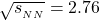 TeV. Physics Letters B, 2011, 696, pp.30-39. ⟨10.1016/j.physletb.2010.12.020⟩. ⟨in2p3-00544311⟩
 - A. Uras, L. Massacrier. Feasibility Study for a Muon Forward Tracker in the ALICE Experiment. International Europhysics Conference on High Energy Physics (HEP 2011), 2011, Grenoble, France. ⟨in2p3-00656806⟩
Powered by HAL 